

by Felipe Diaz-Arango,
Culture Ops Co-Founder
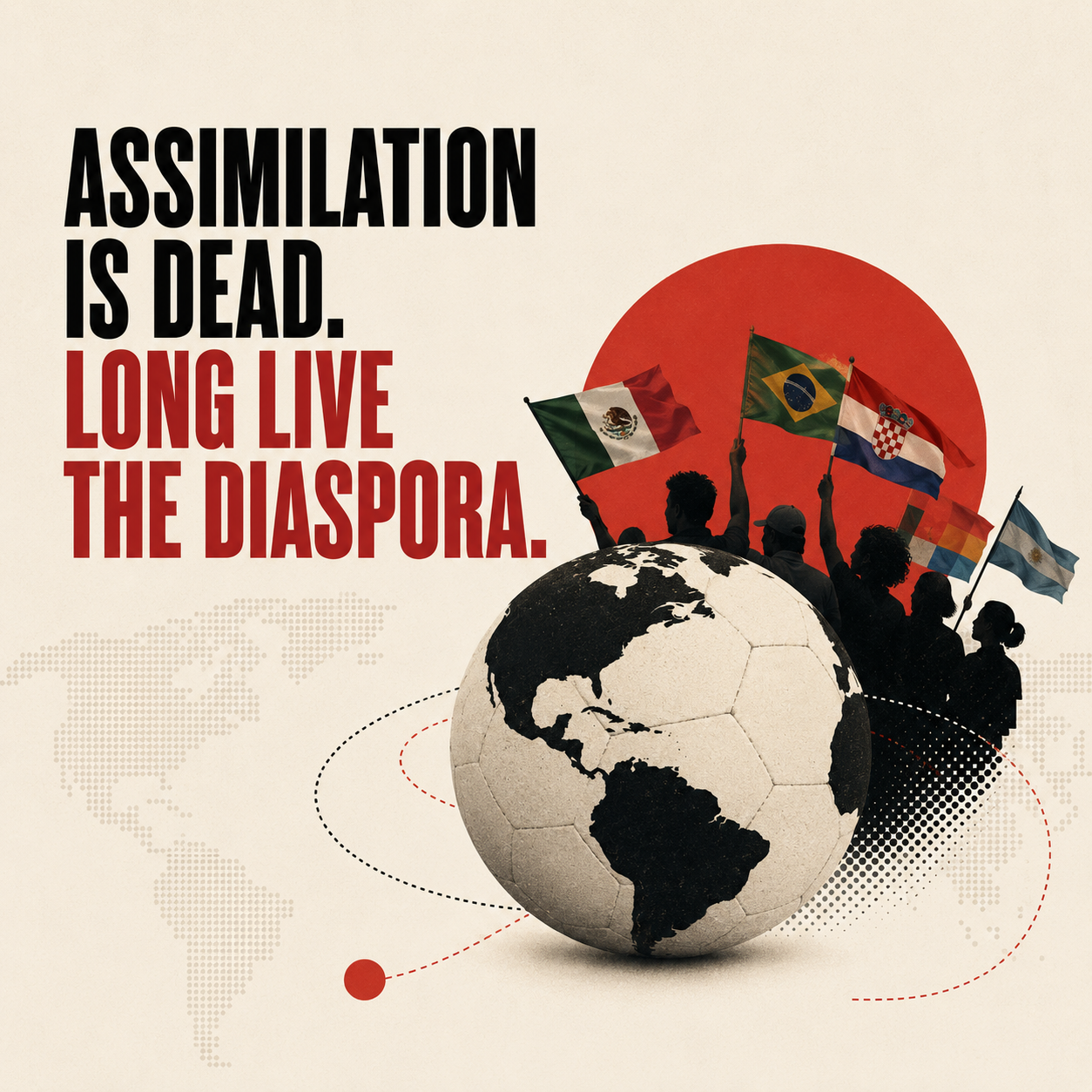
CULTURE SIGNALS: Assimilation Is Dead. Long Live the Diaspora
Lessons from profiling America’s World Cup communities.
As a rabbit hole for my audience design consultancy, I thought it’d be fun to build a brief profile of every World Cup team’s diaspora equivalent here in the US: their rough geographic concentration, categories they’re strong players in, and things of the like. Individually, these profiles are limited by the fact that I threw them together through a fairly surface-level, internet research sprint (though there’s interesting curiosities to delight in for most of them). That said, collectively they led me to draw overall lessons worth thinking about if you’ve got a business you’re trying to grow.
#1 Assimilation is a dead model
A lot of marketing still operates under the classic assimilation story, assuming a one-way path where the longer a community lives in the U.S., the weaker its ties to the origin culture become, all Americans eventually dissolving into a beige soup where all consumers behave alike. That made some intuitive sense in an era when migrants and their descendants had limited ways to keep up with their home country.
But today, because of the internet and globalization, the groups that move to new countries stay incredibly connected to home. Diasporas can watch the same shows, read the same news, listen to the same music, and argue about the same politicians as their counterparts back “home.” Many can even eat the same comfort foods: I was struck by how many micro-businesses focus on shipping hyper-specific products to homesick diaspora households.
The 2026 World Cup made this apparent on the field as well, with the abundance of players born outside the country they play for. Yes, for some this was a practical calculation for playing time. But there were at least a few cases where someone who could have played for a powerhouse like France nevertheless felt enough kinship with their parents’ or grandparents’ country to choose them instead.
In a world where diasporas exert a strong pull and culture is no longer cut off by migration, the old assimilation model completely falls apart. We’re better off thinking of diasporas as defined by networks rather than physical location, where people become fluent in American life AND stay deeply connected to the places their families came from.
#2 Even when it was alive, it was never a one-way street
Even before the internet made it easier, long-tenured American diasporas have kept their cultural identity visible. Many, like Croatians, Swedes, and Scots, have “formalized” their presence through concrete institutions and clubs that have spanned, in some cases, over a century.
And while you may be able to call fourth, fifth, sixth generation descendants “assimilated” (though even that isn’t as clear cut…more on that later) the transition didn’t happen before these communities imbued “mainstream” America with some of their most innovative and beneficial ideas and practices.
Think about the legacy of some long-tenured diasporas on America today:
Czech, Dutch, German, and other immigrant communities whose mutual aid societies, fraternal benefit groups, and cooperative financial models helped shape America’s local financial infrastructure.
Cape Verdeans in New England sustaining transatlantic packet trade networks for decades just so they could stay in touch with their home island.
The (somewhat ethnocentric, in retrospect) assimilation model holds as its ideal foreigners who retain their skills and smarts but who shed their incompatible ideas and attitudes in favor of a superior, “American” way of seeing the world. But I’d argue that it’s precisely in their holding on to their diverse ideas and attitudes that diasporas have enriched this country the most.
#3 The businesses that feel least “ready” for segment / multicultural marketing are the ones poised to benefit most from it
When I invite brand managers or founders of growing brands to think about how specific audiences might give them a launching pad to grow, they often say that their brand isn’t “ready” for that type of “sophisticated” thinking. In short, they see reaching out to specific segments as marginal scaffolding to build on “general market” success, not considering that for many now-dominant brands (ex. Modelo) building a base with a specific audience serves as the foundation to go “general.”
Yes, branching out to a portfolio of specific new segments helps established businesses continue growing after their core bets plateau. But sitting with the World Cup diasporas, I believe more than ever that it’s nascent, challenger, and regional businesses that stand to benefit most from designing their growth around diasporas.
What makes diaspora opportunities more practical than small or regional brands realize? Two factors, in short:
Audience size that repels bigger fish: small brands have a lot more incentive and freedom to pursue modestly sized audiences, while it’s harder for teams in larger brands to justify the effort (large organizations historically haven’t been interested in the effort and thinking that assembling a meaningful portfolio of growth audiences demands, with the exception of the most elite and sophisticated—shoutout McDonald’s as the banner example). This means that small brands have a good chance of keeping these audience for themselves.
Geographic concentration: many groups have a concentration that makes them relatively simple to target locally (think Bosnians in St. Louis, or Ecuadorians in NYC) without a small brand having to stretch itself with a complex and expensive national plan.
In high school and college, I worked as a stocker for Polar Beverages, a regionally beloved soda and seltzer brand and to this day one of my favorite jobs. For my five years there, I saw us claw and struggle for shelf space and customers against the much better-funded Coke and Pepsi.
As I did this exercise, I remembered stores I’d stock where all the clientele was Portuguese, Brazilian, Cape Verdean, etc. They were there the whole time—probably too small for Coke and Pepsi to care, but large enough that Polar, had we cared to notice, could’ve built a fruitful relationship with them that probably translated to more than a few percentage points of growth.
#4 “Retro-acculturation” is a universal American desire, not just a Hispanic one
Above, I mentioned fifth and sixth generation European descendants losing touch with their original culture and fully “assimilating.” But even then, I’ve kinda sold them short. One thing I didn’t see coming is the extent to which even far-removed descendants of diasporas yearn to reconnect with their ancestors’ culture.
“Retro-acculturation” (actively seeking to learn your ancestor’s language, culture, etc.) is well-documented among Hispanic communities. This behavior makes sense to me for them, as they’re relatively more recent diasporas coming up in an age where biculturalism is treated much more like an asset than a liability. What I didn’t realize is how widespread this is with other, more “established” groups like Germans or Scots, who can turn to institutions and programs built around helping people travel back to the land of their ancestors, relearn the language, pick up cultural practices again, etc.
This hunger from distant descendants of certain diasporas (which can number in the tens of millions) for culturally-resonant content and experiences changes the math for even national brands.