

by Felipe Diaz-Arango,
Culture Ops Co-Founder.
CULTURE SIGNALS: Lab Coat Logic is Ruining Your Campaign
Strategists exist, in part, to reassure clients that someone has taken a deliberate, rational look at the campaign. The role emerged in the 1980s partly as a way for agencies to look as serious as the management consultancies eating their lunch. Good strategy adds real creative value beyond that veneer of respectability — but the original instinct never fully went away. Clients still want the adult in the room, and the adult is still expected to be holding "the data."
That expectation is worth questioning, because it rests on a quiet assumption: that a strategist's reasoning is anchored to something close to irrefutable. Clients picture a team poring over numbers, calculating the effect of a campaign with the precision of a scientist charting a meteor. It's a comforting picture. It's also mostly a fiction — and one the industry is happy to keep selling.
Data can strengthen creative work. But too often it becomes a crutch that weakens the work and undermines the very goals it was meant to serve.
The overpromise hiding inside "data-driven"
When an agency or consultancy promises a "data-driven approach," it implies precise, certain outcomes. No one says it outright, but the thing being sold is certainty — the illusion that every variable has been accounted for. That promise creates three predictable problems.
It invites pointless quibbling and delays action. Clients — and strategists who lack conviction — will obsess over small numerical variations even when the big, obvious signal is screaming that it's time to launch. Crunching numbers becomes a respectable substitute for nerve.
It obscures the actual goal. Numbers are useful proxies. But the moment a proxy becomes the target, it starts to corrupt the original purpose. It is often better to act on a clear qualitative signal than on a twisted statistical stand-in for it.
For niche audiences, the data is frequently junk. Reliable, granular data is largely a luxury of wealthy markets and large categories. When an audience or context falls outside that narrow slice — which is exactly where overlooked growth audiences live — the available data tends to be biased, incomplete, or simply absent. In those situations, current qualitative observation isn't a fallback. It's the more honest instrument.
Even science strains under data-obsession
It would be easy to dismiss this as amateurs playing scientist. But the harder truth is that science itself has struggled with the same over-reliance. As psychologist Adam Mastroianni has pointed out, the most-cited psychology paper of all time is an explanation of statistical techniques, and the overwhelming majority of biomedical papers over a 25-year stretch reported at least one p-value. The fixation has led entire fields down dead ends — to the point where, in one now-famous demonstration, standard methods showed "statistically significant" brain activity in a dead salmon.
The lesson isn't anti-rigor. It's that obvious effects, visible to anyone paying attention, often tell us what we need to know without elaborate statistical machinery. Ignoring that is how even careful people end up sophisticated and wrong.
The real mistake: linear thinking in a non-linear world
The deeper issue is that data-obsession pushes teams to apply linear, predictable logic to a domain that is fundamentally stochastic — driven by randomness and an unbounded set of variables.
Clients understandably crave certainty; business training rewards linear thinking. But if marketing actually behaved that predictably, clients wouldn't need agencies or consultants at all. The work exists precisely because the outcome isn't a formula.
Marketing is closer to poker than chess. In chess, enough computing power guarantees the right move. In poker, you can play a hand perfectly and still lose to variance — and the skill is in making good bets repeatedly under uncertainty, not in eliminating it. Modern marketing is, if anything, more unpredictable than poker, with more unknowns in play at once.
Rigor without false precision
None of this is an argument for abandoning discipline. The answer is to keep the rigor that good science is known for while dropping the pretense of precision it never actually had. Consider how scientists worked before statistics dominated the field: they chased big, obvious effects; they made bold hypotheses about strange phenomena; and they tested quickly and directly. Centuries of progress, very little of it waiting on a p-value.
Translated into marketing practice, that looks like three habits.
Play for big, unambiguous effects. Look for the things people clearly respond to — reactions that sit well above the threshold of statistical significance, where you don't need a regression to see that something is happening.
Hunt the obvious signals everyone has stopped noticing. The most valuable insights are usually behaviors and attitudes a category takes for granted and has never bothered to question. The advantage over pure science is that the discovery is rarely new — it's a fresh perspective on something familiar. Relatable and novel is the foundation of work that sticks.
Test cheaply and read the result plainly. Once there's a strong, falsifiable thesis — a campaign idea — the way to validate it isn't a complex data exercise. It's a simple, inexpensive execution put in front of real people. If the work is any good, the effect should be visible without statistical gymnastics. And a polarized reaction is often a better sign than a lukewarm one: a few people loving it and a few hating it beats everyone shrugging.
What we actually sell
Strategy sells educated judgment — logic, rigor, insight, and the discipline to act under uncertainty. It does not sell certainty. Anyone promising certainty is either confused or lying.
For teams sitting on the client side, the most reliable move is to embrace that uncertainty deliberately: make small bets, test them quickly, and double down on the ones showing clear signs of life. Those signs are technically "data," but they're usually the non-numerical kind that won't let you build a bulletproof deck. Getting comfortable acting on that kind of evidence is how the best operators — from venture investors to internet-native businesses — actually win.
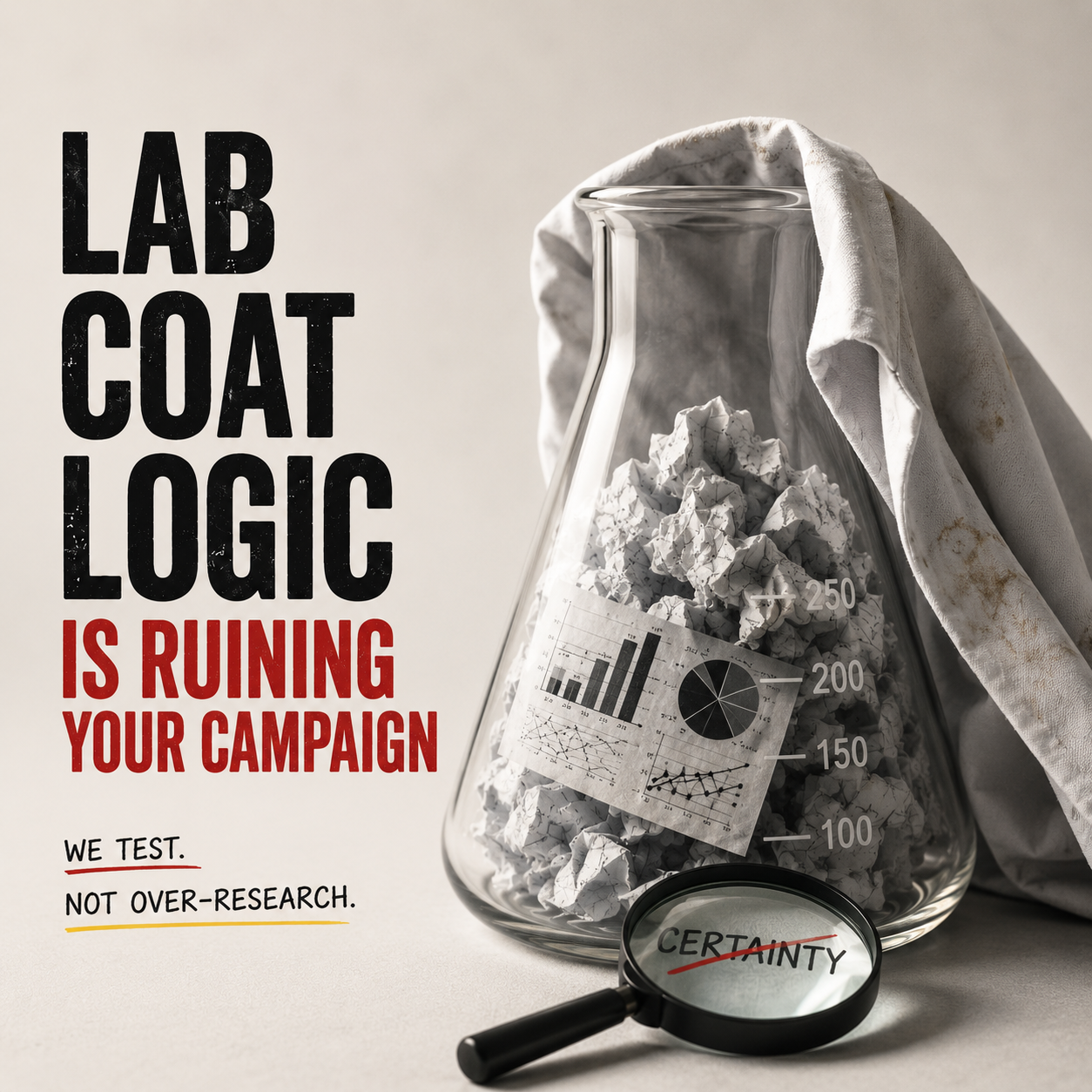
This is also why, at Culture Ops, we test rather than over-research. The audiences a category overlooks are exactly the ones where traditional data is thinnest, so waiting for statistical certainty means waiting forever — or worse, mistaking the absence of data for the absence of opportunity. We'd rather frame a sharp hypothesis, put a low-cost test in front of the right people, and read the obvious signal. The breakthroughs come from looking up from the numbers and out at the world.