

by Felipe Diaz-Arango,
Culture Ops Co-Founder.
CULTURE SIGNALS: THE UNIVERSAL STORY IS FAILING. SPECIFIC ONES STILL SELL.
Why the market outgrew mass narratives, and what brands need instead
Most brands still run on a single, load-bearing story. One narrative, told to the entire market, meant to move everyone in roughly the same direction. It's the model the industry was built on, and for a long time it worked.
It's working less well every year. You can feel it in the numbers before you can name it: the same message that used to carry the whole audience now lands with part of it, costs more to push, and converts a little worse each quarter. The instinct is to treat this as an execution problem — better creative, more spend, sharper targeting on the same idea. Usually it's something deeper. The universal story itself is losing its grip.
The world got too complex for one story to map it
Stories have always worked as maps. They take an overwhelming reality and reduce it to something a person can navigate — what to expect, how to act, what matters. That reduction held up for most of history because, for most of history, people lived inside relatively bounded worlds. Reality changed slowly. New information arrived rarely. A shared story could plausibly describe everyone's experience.
That condition is gone. People now absorb a firehose of contradictory realities, competing explanations, and constant counterexamples arriving at the speed of a feed refresh. The big cultural stories that used to align large populations — the ones a national brand could safely assume its audience all believed — have visibly frayed. When the underlying reality is this fragmented, a single narrative can no longer map all of it.
Other fields that study complex systems (climate, economies, ecosystems) gave up on single predictive formulas decades ago and shifted toward understanding patterns within segments of a system. Marketing is late to the same realization.
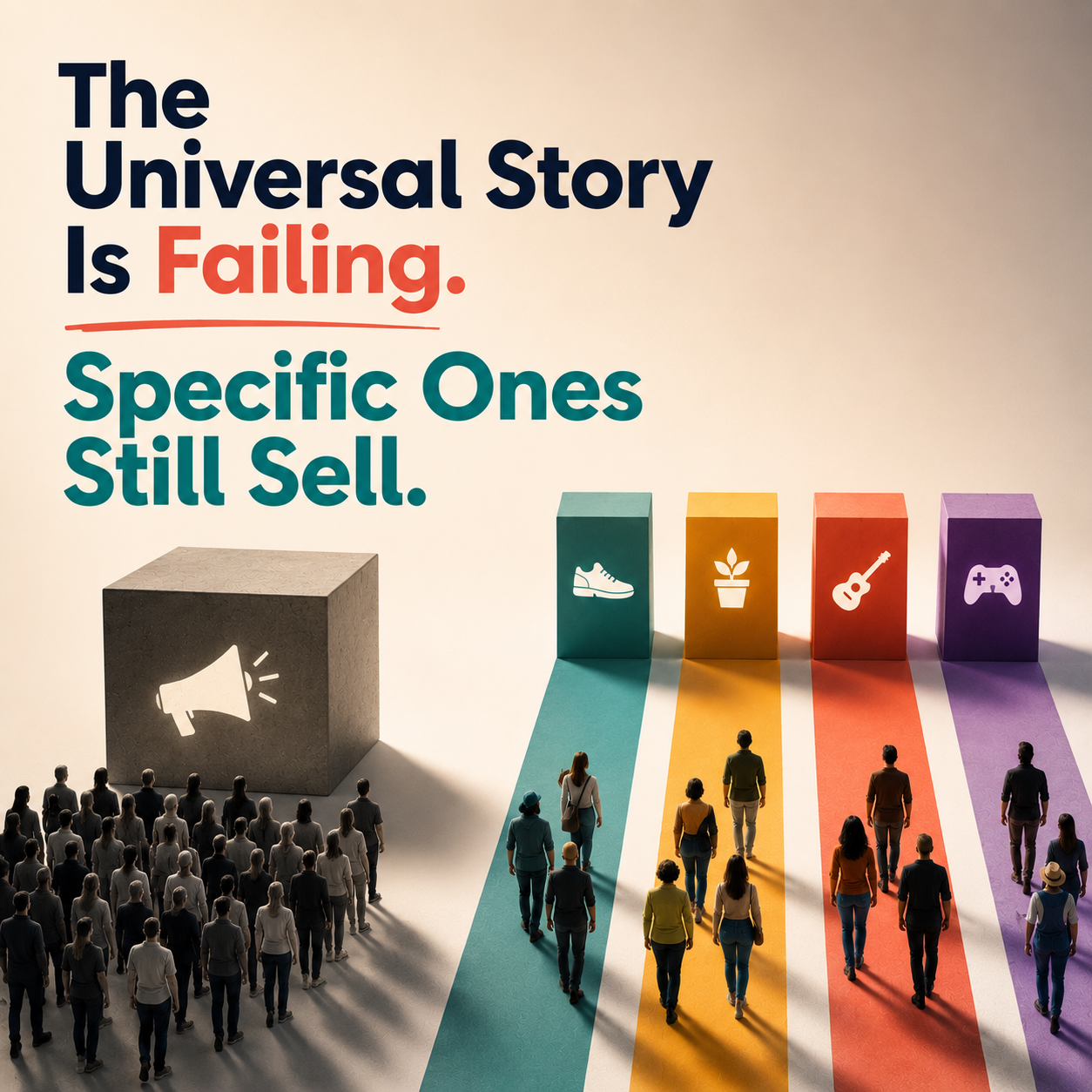
Stories aren't dead. Universal ones are.
The answer isn't to abandon storytelling. It's to stop asking one story to do a job it can no longer do. The brands adapting well are the ones moving from a single universal narrative to specific stories for specific segments, mapping to a particular audience's reality rather than a flattened average of everyone's.
This is counterintuitive to teams trained to prize consistency, but it actually reduces the complexity any single campaign has to carry. A universal story has to be true enough for everyone, which usually means it's vivid for no one. A segment-specific story only has to be true for the people it's built for, so it can be sharper and far more resonant.
The proof of this is mundane and everywhere. The stories that still move people reliably tend to be the narrow ones, built for a defined audience. Before it dominated the world, Facebook catered only to college students and used them as its launching pad. Modelo is now the largest beer in America by dollar sales, but used working class Latinos to gain its initial momentum. Pabst Blue Ribbon rebuilt itself through snowboarders and skaters before becoming the default hipster beer.
What this means in practice
For a marketing leader watching a universal message lose efficiency, the move is not a better universal message. It's a deliberate shift toward segment-level storytelling, with the discipline to find which segments are worth it before betting the budget.
This is the work Culture Ops was built for: finding the segments a category has flattened into the average, and building the specific stories that reach them. It was never optional in the work we came from. Now it's not optional for anyone.
The universal story may be losing steam, but specific ones are just getting started.